
The founders
IIT Delhi graduate; worked at ITC and InMobi before starting up.
IIT Delhi graduate; previously worked in technology roles in Japan and India.
The story
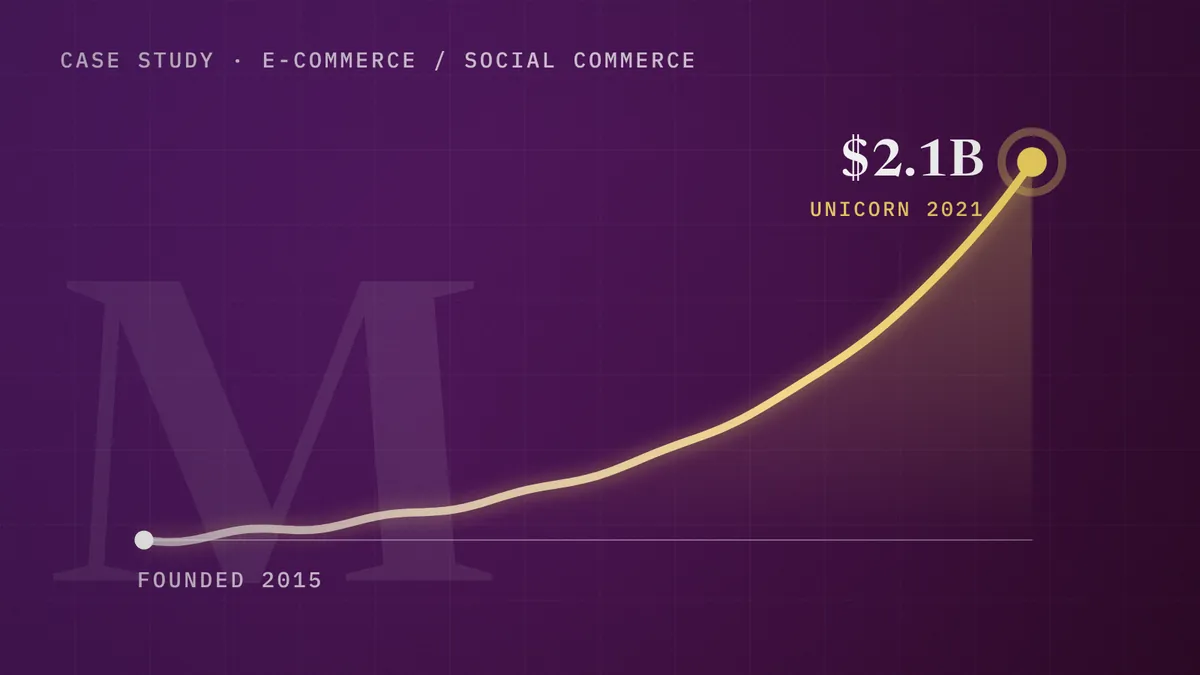
Meesho began in 2015 as FashNear, an app to help local fashion shops sell online. It did not take off — but the founders noticed something more interesting: small sellers and homemakers were already selling products to friends and family over WhatsApp and Facebook.
They rebuilt the company around these resellers. Meesho supplied catalogues, handled payments and delivery, and let resellers add their own margin. Women in smaller towns became a core part of its network, earning income without inventory or a shop.
Over time Meesho evolved into a low-price marketplace aimed at India’s tier-2 and smaller cities, cutting costs for sellers to keep prices low. In April 2021, a $300 million round led by SoftBank Vision Fund 2 valued it at $2.1 billion.
Timeline
- 2015Starts as FashNear; pivots after spotting social reselling behaviour.
- 2016Joins Y Combinator; renames as Meesho (“Meri Shop”).
- Apr 2021$300M Series E led by SoftBank Vision Fund 2 at $2.1B — unicorn.
- Sep 2021Raises again at a higher valuation as it shifts focus to a direct marketplace.
- Dec 2025Lists on NSE and BSE; shares open about 46% above the ₹111 issue price.
How the money came in
| When | Round | Amount | Led by | Valuation |
|---|---|---|---|---|
| Apr 2021 | Series E | $300M | SoftBank Vision Fund 2 | $2.1B |
| Dec 2025 | IPO | ₹5,421 crore | Public markets | Listed |
The methods that worked
Watch what users already do
The pivot came from observing real behaviour — social reselling — rather than defending the original idea.
Build for the next 500 million
Low prices, vernacular-friendly design and a focus on smaller towns opened a market bigger players under-served.
Remove friction for the supply side
Cutting seller costs and simplifying onboarding attracted small manufacturers and traders in large numbers.
Keep evolving the model
Meesho moved from reseller-led social commerce to a direct marketplace when the data showed where growth was.
The hard parts
- Long early years with modest growth before the model clicked.
- Keeping logistics costs low enough for very cheap products.
- Restructuring and layoffs as the business model shifted.
Lessons for Indian founders
- Pivots are normal: FashNear → reseller platform → marketplace.
- Price-sensitive markets can be huge if your cost structure is built for them.
- Distribution through people (resellers) can beat paid advertising early on.
Conclusion
Meesho reached unicorn status by following its users — and later the public markets — by staying obsessed with low prices for India’s smaller cities.
The Founder Playbook includes Build Your Unicorn, a simulation of hiring, capital and fundraising.
Sources
- Bloomberg Quint — Meesho becomes unicorn after SoftBank-led round (Apr 2021)
- Business Standard — Meesho shares debut with 46% premium (Dec 2025)
Educational summary based on public reporting. Meesho is a trademark of its owner; The Revenue is not affiliated with the company. Figures are as reported at the time and may since have changed. Spotted an error? Tell us.