
The founders
Left Stanford University to build in India; had started earlier ventures as a teenager.
Also left Stanford; leads the technology that runs dark-store operations.
The story
During the 2020 lockdowns, Aadit Palicha and Kaivalya Vohra saw how hard it was for people in Mumbai to get groceries. Their first attempt, KiranaKart, tried to deliver from neighbourhood kirana shops. It taught them the real problem: delivery times were slow and unreliable because they did not control the stores.
In 2021 they relaunched as Zepto with a different design: small “dark stores” — warehouses closed to walk-in customers — placed inside dense neighbourhoods, stocking a few thousand fast-moving items. Short distances made a 10-minute delivery promise possible.
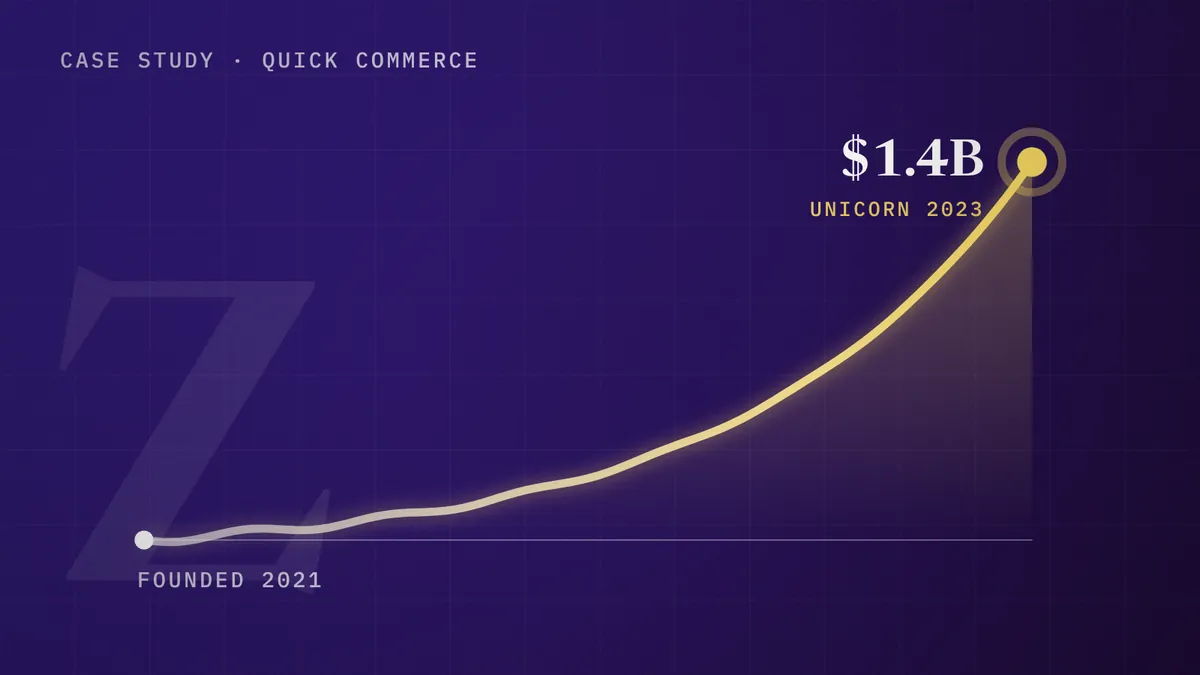
The promise was easy to understand and easy to talk about. Zepto expanded city by city, raising money quickly to fund new stores and fight well-funded rivals. In August 2023 a $200 million round led by StepStone Group valued it at $1.4 billion, making it India’s first unicorn of 2023 — about two and a half years after launch.
Timeline
- 2020KiranaKart experiment during lockdown — learns that store control matters.
- 2021Zepto launches in Mumbai with dark stores and a 10-minute promise; backed by Y Combinator and others.
- 2022Series D of $200M led by YC Continuity at about $900M valuation.
- Aug 2023Series E of $200M led by StepStone Group at $1.4B — unicorn.
- 2024Raises $665M at $3.6B (June) and $340M at $5B (August).
How the money came in
| When | Round | Amount | Led by | Valuation |
|---|---|---|---|---|
| 2022 | Series D | $200M | YC Continuity | ~$900M |
| Aug 2023 | Series E | $200M | StepStone Group | $1.4B |
| Jun 2024 | Series F | $665M | Multiple investors | $3.6B |
| Aug 2024 | Follow-on | $340M | General Catalyst | $5B |
The methods that worked
Fix the bottleneck, not the symptom
KiranaKart showed that depending on third-party stores made speed impossible. Owning the dark stores gave Zepto control over stock, picking and delivery time.
A promise customers can repeat
“Groceries in 10 minutes” is a product, a brand and a marketing line in one sentence.
Density before spread
Stores are placed where order density is highest, because every extra kilometre adds minutes and cost per order.
Operations as the product
Picking time, packing time, rider routing and stock availability are measured obsessively — in quick commerce, ops metrics are the customer experience.
Raise ahead of a land grab
In a race against big rivals, Zepto raised capital fast to secure locations and suppliers before the market consolidated.
The hard parts
- Very high cash burn while building store networks.
- Intense competition from deep-pocketed rivals in the same cities.
- Public scrutiny of rider safety and working conditions under tight delivery promises.
Lessons for Indian founders
- Your first idea is often a research project — keep the insight, change the model.
- In operations-heavy businesses, the unit to perfect is one store, one order, one rider.
- Speed of execution can beat incumbents, but only if unit economics can eventually work.
Conclusion
Zepto shows how a sharp customer promise, backed by an operating model designed around it, can create a new category — and how capital-intensive that race becomes.
The Founder Playbook includes Build Your Unicorn, a simulation of hiring, capital and fundraising.
Sources
- Business Today — StepStone investment makes Zepto a unicorn (Aug 2023)
- Outlook Business — Zepto raises $340M at $5B (2024)
Educational summary based on public reporting. Zepto is a trademark of its owner; The Revenue is not affiliated with the company. Figures are as reported at the time and may since have changed. Spotted an error? Tell us.