




RBI raises the repo rate to 5.50%: what it means for your EMI and FD
The RBI's first rate hike since February 2023, explained: the new rates, the shift to 'calibrated tightening' and what a 0.25-point rise does to a home loan EMI.

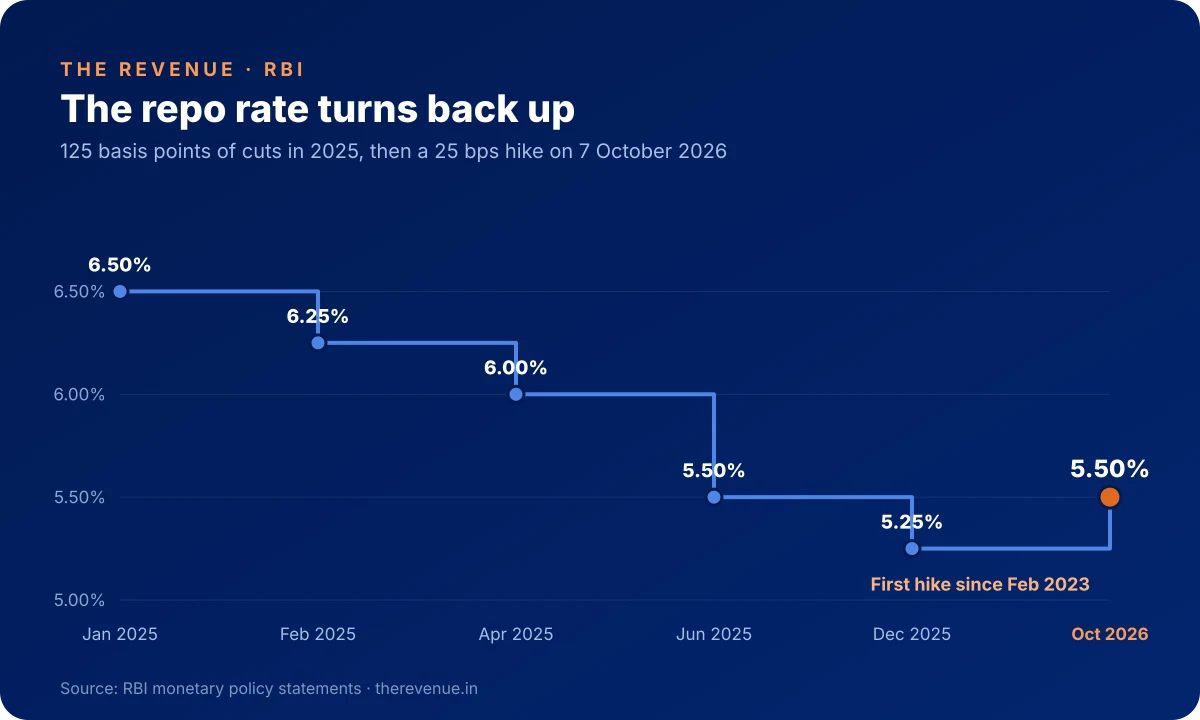
The Reserve Bank of India (RBI) has turned. After cutting the repo rate by a total of 1.25 percentage points in 2025, its Monetary Policy Committee (MPC) raised it by 25 basis points to 5.50% at the end of its 5–7 October 2026 meeting. This is the RBI’s first hike since February 2023. The repo rate is what the RBI charges banks for short-term loans, and it sets the tone for interest rates across the economy.
The new rates at a glance
| Rate | Now | What it is |
|---|---|---|
| Repo rate | 5.50% | What banks pay to borrow overnight from the RBI |
| Standing Deposit Facility (SDF) | 5.25% | What the RBI pays banks for parking spare cash |
| Marginal Standing Facility (MSF) and Bank Rate | 5.75% | The emergency borrowing rate for banks |
The RBI also changed its stance from “neutral” to “calibrated tightening”. That means it is leaning towards higher rates but will move carefully, one meeting at a time. Reports differ on the vote. Some say all six members backed the hike and four of the six backed the change in stance, while others describe the whole decision as unanimous.
Why the RBI raised rates
Prices are rising faster. Retail inflation rose to 5.54% in September, up from 4.83% in August, and food inflation was 7.74% (read our inflation explainer). The RBI expects inflation to average 5.2% this financial year, well above its 4% target. With oil above $100 a barrel because of the conflict in West Asia, the RBI is trying to stop higher prices from spreading.
One way to see it: with the repo rate at 5.50% and expected inflation at 5.2%, the “real” rate is only about 0.3 percentage points. Monetary policy is still not tight. It is just less loose than before.
What it does to your EMI
Most new floating-rate home loans are linked to the repo rate. When the repo rate rises, your bank’s lending rate rises with it, usually from the next reset date in your loan agreement. One report says the revised rate can apply from 8 October 2026 or from the borrower’s next scheduled reset.
Here is what a full 0.25-point rise does, assuming your loan rate moves from 8.00% to 8.25%. These are our own calculations, for illustration only.
| Loan | EMI at 8.00% | EMI at 8.25% | Extra per month |
|---|---|---|---|
| ₹50 lakh home loan, 20 years | ₹41,822 | ₹42,603 | +₹781 |
| ₹30 lakh home loan, 20 years | ₹25,093 | ₹25,562 | +₹469 |
| ₹10 lakh loan, 5 years | ₹20,276 | ₹20,396 | +₹120 |
Many banks keep your EMI the same and add months to the tenure instead. On the ₹50 lakh example, that is roughly 12 extra EMIs. If you would rather keep the tenure, ask your bank to raise the EMI. Over the life of the loan, that usually means paying less interest.
Try your own numbers with our loan EMI calculator, or see how the repo rate reaches your EMI.
What it means for savers
- Fixed deposits: banks may raise FD rates, but usually later and by less than loan rates go up. If you were waiting to lock in, watch your bank’s card rates over the next few weeks.
- Debt mutual funds: when rates rise, the prices of existing bonds fall. That hurts longer-duration funds the most for a while.
- Your real return: with inflation above 5%, a 7% FD earns very little after inflation and tax. Our inflation and savings guide explains why.
What to watch next
- October inflation, due in mid-November. If it stays above 5.5%, another hike becomes more likely.
- Crude oil and the rupee. These are the two main drivers of imported inflation.
- How quickly your bank passes on the hike. Check your loan’s reset date and benchmark.
This is an explainer, not financial advice. EMI figures are illustrative and assume a full pass-through of the repo rate change.
Sources
- SCC Online: RBI hikes repo rate to 5.50% (October 2026)
- CA Club India: RBI hikes repo rate by 25 basis points to 5.50%
- TMGM: What “calibrated tightening” means for loans, deposits and investments
- CNBC: India’s retail inflation jumps to 5.54% in September
- Reserve Bank of India: rbi.org.in (monetary policy statements)
This article is for education only, not personalised investment, tax or legal advice. Rules and rates change. Check the latest official sources or a qualified professional before acting. Spotted an error?Tell the editor.