





Jio Platforms IPO opens 21 October: price band, lot size, dates and what to check
India's biggest-ever IPO: Jio Platforms is raising about ₹30,200 crore at ₹1,065–1,119 a share. Key dates, how much you need and what to read first.

Reliance’s telecom and digital arm, Jio Platforms, opens its initial public offering (IPO) on Wednesday, 21 October 2026. At roughly ₹30,200 crore (about $3.2 billion), it is reported to be the largest IPO in India’s history. Jio’s existing backers include Meta and Google. Bidding from anchor investors, the large institutions that get shares before the public, was scheduled for today, 19 October.
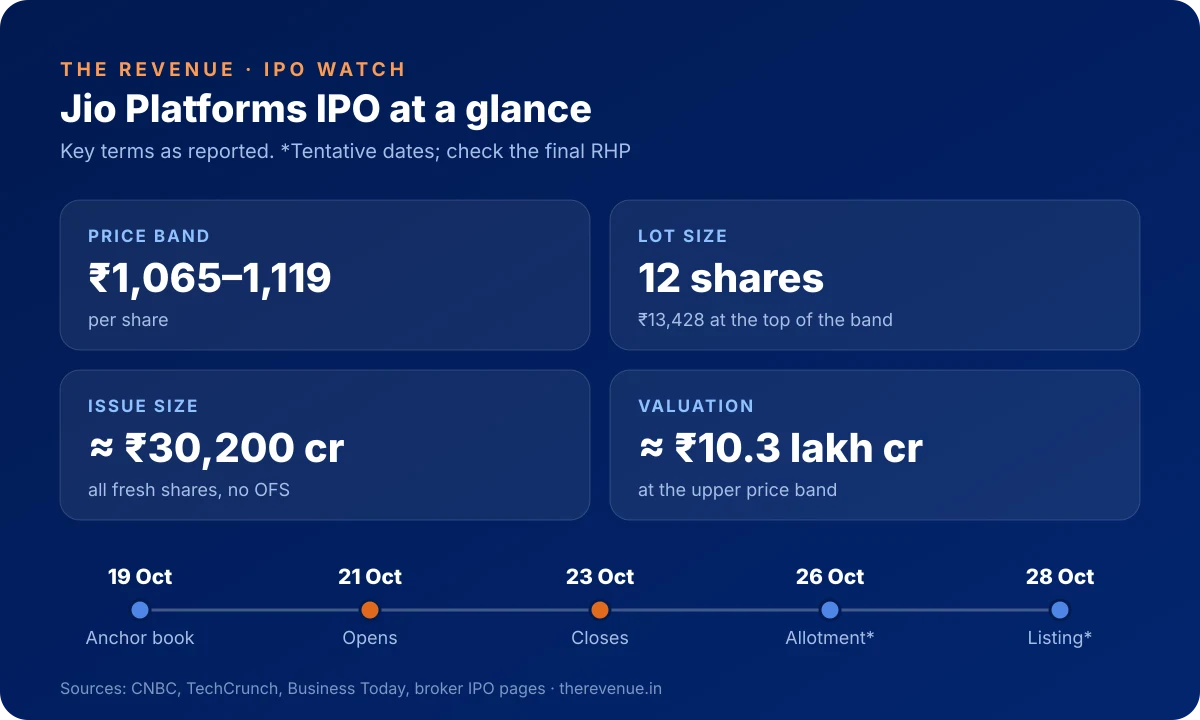
Key details
| Price band | ₹1,065 – ₹1,119 per share |
| Lot size | 12 shares (₹13,428 at the upper end) |
| Issue size | About ₹30,200 crore; reports range from ₹30,188 crore to ₹30,213 crore |
| Type | Fresh issue only, about 27 crore shares; no offer for sale |
| Anchor book | About ₹8,000 crore; bidding on 19 October |
| Opens / closes | 21 October / 23 October 2026 |
| Allotment | 26 October (tentative) |
| Listing | 28 October on NSE and BSE (tentative) |
| Implied valuation | About ₹10.3 lakh crore (~$108 billion) at the upper band |
Because the issue is entirely fresh shares, the money goes to the company rather than to existing shareholders selling out. The offer document explains how the company plans to use it.
How much demand is there?
Business Today reported that the anchor book was expected to draw bids worth more than $20 billion. Global investors such as BlackRock, ADIA (the Abu Dhabi Investment Authority) and Norges Bank are among those said to be seeking shares. These are reports of interest, not final bids. Subscription numbers will be published by the exchanges once the issue opens.
You may also see a grey market premium (GMP) quoted, such as ₹249 a share. The GMP is an unofficial price from an unregulated market. It can change quickly and says nothing certain about listing day.
How to apply
You need a demat account, and your money is only blocked through ASBA or a UPI mandate. It is debited only if you get shares. Our step-by-step guide, How to apply for an IPO in India, covers lots, cut-off price, allotment and refunds.
A few practical points:
- Bid at the cut-off price if you are a retail investor and want to be sure your price is accepted.
- More lots rarely help in a hugely oversubscribed issue. Retail allotment is often decided by lottery, one lot per winning applicant.
- Separate PANs mean separate applications, for example for a spouse or parent, each with their own demat account.
What to read before you bid
- The red herring prospectus (RHP) on the SEBI, NSE or BSE websites. It covers the business, the risks, the debt and how the money will be used.
- Valuation. At about ₹10.3 lakh crore, the price assumes strong growth in users and average revenue per user (ARPU). Compare it with listed telecom peers.
- Your own plan. A big-name IPO is still a single stock. Don’t stretch your emergency fund for a listing-day gain.
This article explains a public issue using reported terms. It is not a recommendation to apply. Check the final RHP and exchange notices for confirmed details.
Sources
- CNBC: Meta- and Google-backed Jio Platforms to raise up to $3.2 billion in historic IPO
- TechCrunch: Ambani’s Jio seeks to raise $3.2B in what could be India’s biggest IPO
- Business Today: Jio Platforms IPO anchor book to draw bids over $20 billion
- Chittorgarh: Jio Platforms IPO dates and price
- Groww: Jio Platforms IPO review
This article is for education only, not personalised investment, tax or legal advice. Rules and rates change. Check the latest official sources or a qualified professional before acting. Spotted an error?Tell the editor.