




Trump waives the 100% Russian-oil tariff threat: what it means for India and markets
The US has paused the Graham Act's tariffs on big buyers of Russian oil, including India. What was waived, how markets reacted and why the relief may not last.
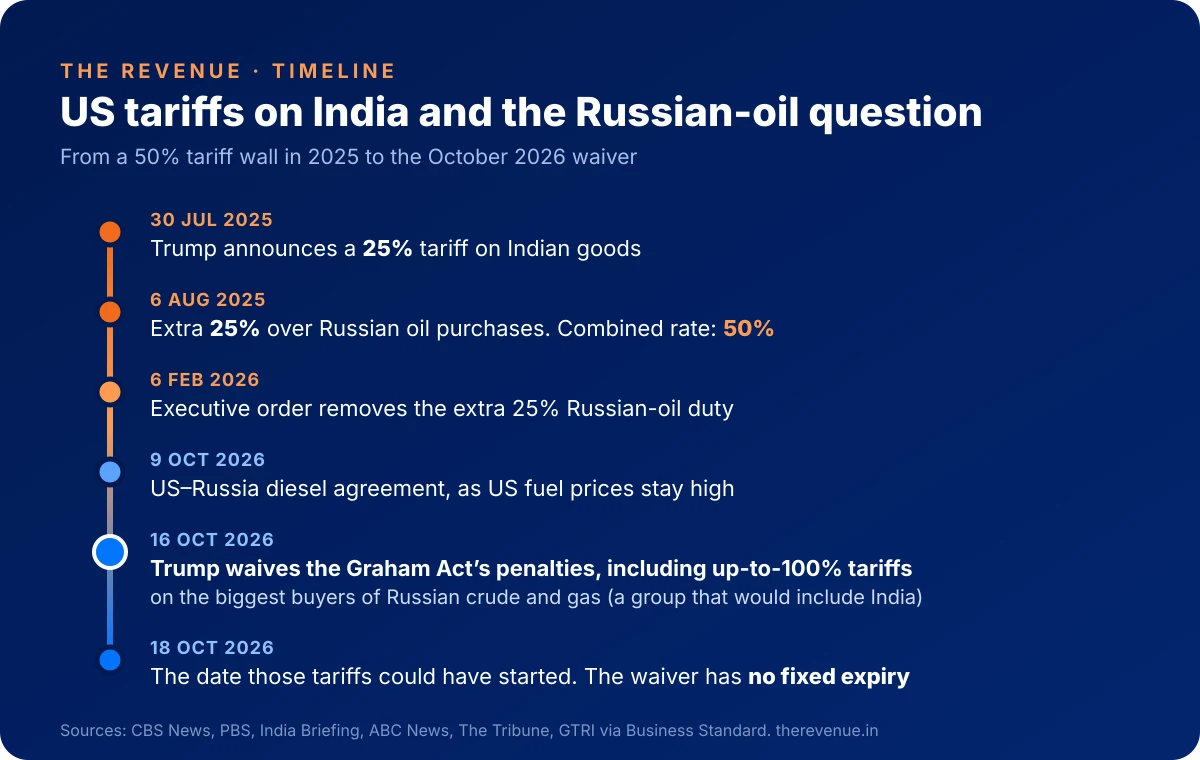
India has avoided a fresh US tariff shock, at least for now. On 16 October 2026, President Donald Trump signed an order waiving the main penalties in the Russia sanctions law backed by Senator Lindsey Graham, often called the Graham Act. Among them was a tariff of up to 100% on goods from the biggest buyers of Russian oil and gas. India and China are among those buyers.
The tariffs could have applied to fresh purchases from 18 October. Trump signed the waiver two days before that date and told Congress it was in the US “national interests” to hold back some of the sanctions.
What exactly was waived
The law gave Washington three main weapons. The order sets all three aside.
| Measure in the law | What it allowed | Status after 16 October |
|---|---|---|
| Tariff on Russian goods | Duties of up to 500% on imports from Russia | Waived |
| Tariff on big energy buyers | Duties of up to 100% on the top five buyers of Russian crude and gas | Waived |
| Sanctions on evasion helpers | Penalties on the top countries helping Russia get around oil sanctions | Waived |
Two details matter:
- This is a pause, not a repeal. The law stays in place. The waiver has no fixed expiry date. It can be lifted if the President or the Secretary of State decides further action is needed.
- Older sanctions still apply. Russia sanctions imposed earlier by executive order are not affected.
Why Washington stepped back
The reports point to energy prices. Oil is already expensive because of the conflict in West Asia and disruption around the Strait of Hormuz. A 100% tariff on India and China, two of the world’s largest crude importers, could have pushed prices higher still. Just a week earlier, on 9 October, the US had agreed to buy Russian diesel to ease its own fuel shortages, according to the Global Trade Research Initiative (GTRI).
GTRI, a Delhi think tank, gave another reason. Targeting India could have derailed the bilateral trade talks now under way.
The relief comes with a catch
GTRI’s verdict: “For India, the waiver buys time but offers no lasting certainty.” Its founder, Ajay Srivastava, warned that Washington can bring the tariffs back at any time. He advised India to:
- protect its energy security and buy oil on commercial terms,
- prepare for renewed US pressure,
- avoid offering permanent trade concessions in return for temporary tariff relief.
There is history here. In August 2025, the US added a 25% penalty on Indian goods over Russian oil purchases. With the existing 25% tariff, that took the total to 50%. The penalty was removed by an executive order in February 2026, as part of an interim trade framework. Exactly which US tariff rates apply to Indian goods now is still being reported differently, so exporters should check current US customs notices for their products.
How markets reacted
Crude oil. Brent crude futures fell about 1.9% to $107.8 a barrel on Monday, 19 October. US WTI fell about 1% to around $100.4. That followed Brent’s brief move to $110 on Friday, its highest level since May.
Indian shares. The Sensex and Nifty opened roughly flat. Early on Monday, the Sensex was near 74,660 and the Nifty near 23,120, each down about 0.1%. High crude prices offset relief over tariffs and strong bank earnings. On 15 October, the Sensex had jumped 2.1%, or 1,534 points, to 74,315.61 as oil fell.
For India, oil matters more than almost anything else. The country imports most of the crude it uses. A cheaper barrel means a smaller import bill, less pressure on the rupee and lower costs for oil marketers, paint makers, airlines and chemical companies. A dearer barrel does the opposite.
What to watch next
- Whether the waiver holds. It has no expiry date, so any change in US–Russia relations could bring the tariffs back quickly.
- India–US trade talks. A signed deal with clear tariff rates would give exporters more certainty than a waiver can.
- Brent crude near $100–110. For Indian markets, this matters more than the tariff headline. Watch it alongside the rupee.
- Refiners’ Russian crude buying. Any sharp change in India’s import mix could draw fresh US attention.
This article explains a news event. It is not investment advice. Figures are taken from the reports linked below and may change as markets move.
Sources
- The Tribune: Trump waives Russia-related US sanctions that threatened 100% tariffs on India, China
- ABC News: Trump signs order waiving Graham Act sanctions on Russia
- CBS News: Trump waives tariffs on largest buyers of Russian oil
- Business Standard: Trump’s sanctions waiver offers India temporary relief, no certainty: GTRI
- ANI: Trump’s Russian oil tariff waiver offers India relief, but experts warn of renewed US pressure
- Business Standard: Market close, 15 October 2026
- PBS NewsHour: Trump adds 25% on India, bringing combined tariffs to 50%
- India Briefing: US–India interim trade agreement
This article is for education only, not personalised investment, tax or legal advice. Rules and rates change. Check the latest official sources or a qualified professional before acting. Spotted an error?Tell the editor.